"I'd need a licence"
Not to act as a location for Anytime Capital's platform. Anytime Capital is the registered money services business and carries the compliance programme for the activity.
The customer at your window on payday is the best crypto buyer in America. Right now they walk down the street to a machine that overcharges them.
$300.00
Bitcoin · part of a cashed payroll check
You check ID before you hand over money. You handle cash carefully. You keep records. You explain a fee to a customer. That is this job.
What is new is the money. Check cashing fees are capped in most states. Crypto is not. And your customers are already asking for it — ask your cashiers how often.
What check cashers tell us
Every objection here is real, and every one of them is about the way crypto has previously been offered to stores rather than about crypto itself.
Not to act as a location for Anytime Capital's platform. Anytime Capital is the registered money services business and carries the compliance programme for the activity.
There is no machine. The whole service is a browser tab on a phone, a tablet or the PC already behind your window.
They do not need to. The screen asks for an amount and an asset. It is a shorter flow than a domestic wire.
You never buy or hold crypto. You take the customer's payment and the platform delivers the asset. There is no float to fund and no price risk on your books.
Your staff are backed by 24/7 US-based support, and orders are attributable to the employee who placed them, so a question has an answer rather than a shrug.
This one ships you nothing. No hardware, no phone line, no shelf space, no cash drawer to reconcile.
Getting started
Your state check casher or money transmitter licence, entity documents and ownership information. Most of it is paperwork you keep at the front of a file already.
We confirm what we can offer at your specific location, in your specific state, and agree the transaction limits your store will operate under.
One short session each. The order screen is deliberately shorter than the wire screen your staff already use.
Go live before a Friday, not after one. The first week is usually the customers who have been asking you for months.
Your brand
Your sign-in page will carry your store's logo and your store's colours. Your customer sees the shop they already know, not a company they have never heard of.
That is the difference between this and a branded machine in your corner. The machine sells someone else's name in your shop. This sells yours.
Pick a colour to see it. This is a mockup — send us your logo during onboarding.
$500.00
Bitcoin · paid in cash
The arithmetic
You keep a share of every order. Bigger order, bigger share. The examples below use 1% to 3% — your own rate is in your agreement.
| At the counter | Order size | Store keeps (low) | Store keeps (high) |
|---|---|---|---|
| A customer cashes a check and puts part of it into Bitcoin | $200 | $2.00 | $6.00 |
| A regular buys USDT to send to family overseas | $500 | $5.00 | $15.00 |
| A customer sells crypto and takes the cash | $1,000 | $10.00 | $30.00 |
| A small business owner buys on payday, every other week | $2,500 | $25.00 | $75.00 |
| One larger order, the kind an ATM's daily cap refuses | $10,000 | $100.00 | $300.00 |
The figures above are worked examples, not projected or guaranteed earnings. They show how the arithmetic works on a given order size at an illustrative revenue-share range. Your actual rate is set in your agent agreement, and what any individual store earns depends on its foot traffic, its neighbourhood, its hours and how many customers it serves. Anytime Capital does not promise any level of income.
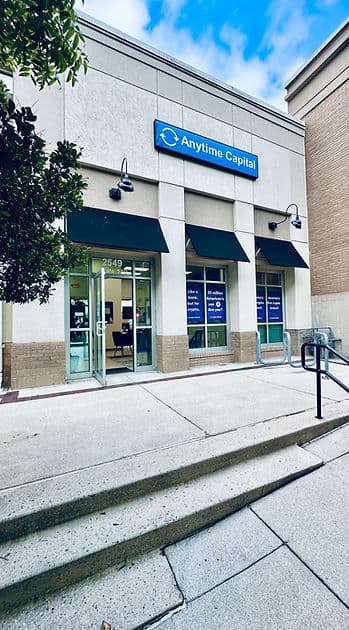
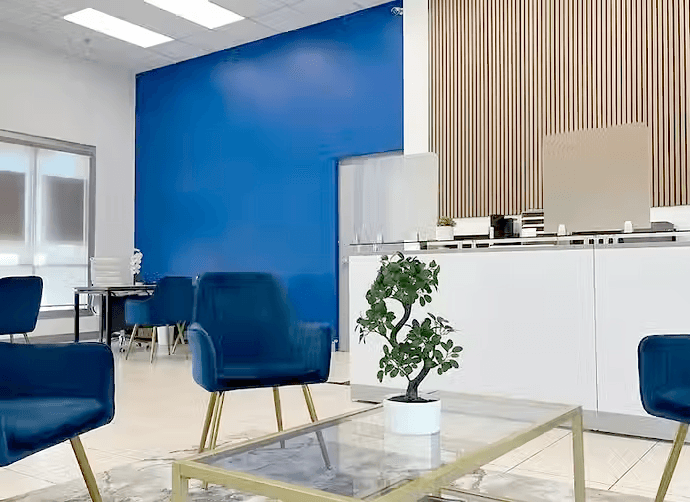
Anytime Capital runs its own branches in Atlanta and Miami. Partner stores run the same counter service.
Think about what a check casher earns per customer interaction. A money order is measured in cents. A bill payment is a flat fee of a dollar or two. A prepaid card load is a small fixed amount. A domestic wire is a flat commission that does not change whether the customer sends $200 or $2,000. Check cashing itself is a percentage, but one a state legislature has capped.
Crypto is the only product on that list where the store's revenue scales with the size of the order and is not fixed by statute. It is also the only one where the customer arrives already wanting it rather than needing to be sold. That combination is why the product is worth the counter space it does not take up.
None of this replaces anything. Nobody is asking you to stop cashing checks. The point is that the same customer, in the same visit, on the same rent, can generate a second transaction.
The core customer is cash-paid and thin-file: someone who has a paycheck or a settlement in their hand and no straightforward route into a bank-account-only exchange. For that person, a store counter is not a worse option than an app — it is the only option that works at all, which is precisely why the kiosk industry exists.
A second group is remittance-driven. Families sending money home have discovered that stablecoins move faster and cheaper than the alternatives, and they increasingly arrive asking for USDT or USDC by name. If your store already handles money transfer, those customers are standing in your line today.
A third group simply distrusts machines. They have used a kiosk, seen what the screen quoted against what they got, and decided they would rather deal with a person. Your store's advantage over a kiosk is not technology. It is that a human being is accountable for the transaction.
Crypto volume in a check cashing store follows the same curve as everything else you do: it peaks on Friday afternoon, it peaks harder on the first and fifteenth, and it is quiet on a Tuesday morning. That is convenient, because it means the service loads your counter at exactly the hours your staff are already there.
It also means the training that matters is not about Bitcoin. It is about the Friday queue: how a cashier fits a two-minute onboarding into a line of eight people, when to ask a customer to start the verification on their own phone while they wait, and how to hand a regular straight through to the order screen because they were verified three weeks ago.
Stores that treat crypto as a Friday product rather than a novelty get to volume much faster. The first month is about your regulars discovering you can do it at all.
Keep reading
The specifics behind the pitch, in the order store owners ask for them.
No. Check cashers are the closest fit, but bodegas, gas stations, currency exchanges, pawn shops, phone stores and tax offices run the program too. Holding a state check casher or money transmitter licence usually shortens the conversation, because your business is already known to a regulator and already runs the recordkeeping this activity expects.
Acting as a serving location for Anytime Capital does not replace or affect the licences your store already holds. Your obligations under those licences remain yours. What we can tell you specifically about your state is part of the onboarding review, and it is not legal advice — most stores confirm the position with their own compliance counsel, which we encourage.
For buy orders, none — the customer pays you, not the other way round. Cash-out capability for sell orders depends on your store's own cash position and the limits agreed during onboarding, which is why it is set per location rather than announced on a web page.
Every order is placed under a named employee login, against a verified customer identity, with the delivery recorded on a public blockchain. There is a stronger evidence trail on a crypto order than on almost anything else your store does.
Yes. Multi-location operators are the common case rather than the exception, and each location gets its own set of employee logins and its own reporting so you can see performance store by store.
Anytime Capital's published rates, which are set out in full on the fees and limits page. The store's revenue share does not change what the customer is quoted, and your cashier shows the customer the price before the order is placed.
There is no platform fee to your store and no equipment cost to recover. Any minimums that apply to a particular market are covered in your agent agreement rather than assumed here.
Tell us where your store is and what your customers keep asking for. We will tell you what we can offer at your location.