Your existing network relationships
Unaffected. This is a separate service on the same counter. Check your own agent agreements for exclusivity language, as some contain it.
Signing up as a money transfer agent meant putting a regulated service on your counter, training your staff on someone else's screen and taking a share of each transaction. This is that decision again, for a product your customers are asking about more often than they ask about wires.
$400.00
USDT · sent by a remittance customer
A money transfer agent already does every hard part of this job. Your staff take identification before they move money. They read a quote back to a customer. They collect cash. They keep records. They work inside a compliance programme written by somebody else and delivered to them as a screen and a training module. Adding crypto changes the screen, not the job.
The customer overlap is even stronger than the operational one. The person sending money home every two weeks is the one most likely to have already looked at stablecoins. The corridor they send into has usually worked out that USDT moves in minutes and does not care what day it is.
That is the honest version of the pitch. Crypto is not a replacement for your transfer business and this is not an argument for dropping a network you have run for fifteen years. It is a second answer for the customer who asks whether there is a faster or cheaper way, and today that customer leaves your store to find out.
Where it fits
Agents ask a version of the same six questions. Here they are with the honest answers.
Unaffected. This is a separate service on the same counter. Check your own agent agreements for exclusivity language, as some contain it.
Yours stay yours. Anytime Capital carries the MSB registration and the compliance programme for the crypto activity specifically.
No terminal, no branded signage requirement, no dedicated position. A browser tab on a device you already have.
One session. Anybody who can complete a send form can complete a crypto order — the flow is shorter.
Delivery in minutes to a wallet the customer controls, with a public blockchain record as the receipt.
A percentage-based share instead of a flat commission, so the number moves with the size of the order.
Your brand
Your sign-in page will carry your store's logo and your store's colours. Your customer sees the shop they already know, not a company they have never heard of.
That is the difference between this and a branded machine in your corner. The machine sells someone else's name in your shop. This sells yours.
Pick a colour to see it. This is a mockup — send us your logo during onboarding.
$500.00
Bitcoin · paid in cash
The arithmetic
You keep a share of every order. Bigger order, bigger share. The examples below use 1% to 3% — your own rate is in your agreement.
| At the counter | Order size | Store keeps (low) | Store keeps (high) |
|---|---|---|---|
| A customer cashes a check and puts part of it into Bitcoin | $200 | $2.00 | $6.00 |
| A regular buys USDT to send to family overseas | $500 | $5.00 | $15.00 |
| A customer sells crypto and takes the cash | $1,000 | $10.00 | $30.00 |
| A small business owner buys on payday, every other week | $2,500 | $25.00 | $75.00 |
| One larger order, the kind an ATM's daily cap refuses | $10,000 | $100.00 | $300.00 |
The figures above are worked examples, not projected or guaranteed earnings. They show how the arithmetic works on a given order size at an illustrative revenue-share range. Your actual rate is set in your agent agreement, and what any individual store earns depends on its foot traffic, its neighbourhood, its hours and how many customers it serves. Anytime Capital does not promise any level of income.
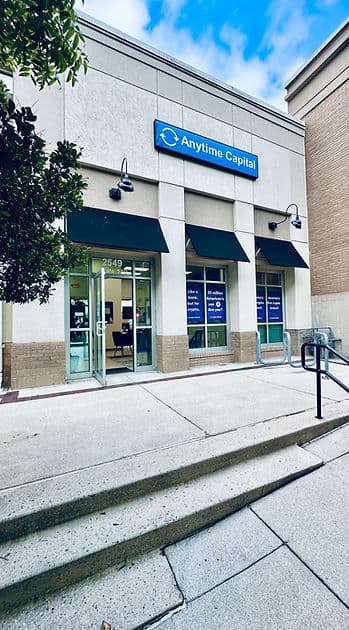

Anytime Capital runs its own branches in Atlanta and Miami. Partner stores run the same counter service.
In corridor after corridor — Latin America, West Africa, South and Southeast Asia — the practical alternative to a cash-to-cash transfer has become a dollar-denominated stablecoin. Not because of ideology, but because it settles in minutes, on a weekend, at a cost that does not scale with urgency.
For a store, that trend is either a threat or a product. It is a threat if the customer figures it out on their own phone and stops coming in. It is a product if the customer can do it at your window, with your staff, and you earn on it.
USDT and USDC are both supported, across several networks, which matters because the network determines the fee and the address format. If your customers send into a corridor where one network dominates, that is a conversation worth having with the retail team during onboarding.
A cash-to-cash transfer needs a sender, a receiver, a destination country, a payout method and a chain of details that can go wrong at the other end. A crypto order needs an asset, an amount and a wallet address. It is a shorter form with fewer ways to fail, and the delivery is confirmable on a public ledger rather than by a phone call to a payout agent.
What it does not do is put cash into a relative's hand on the other side. That is still the transfer network's job, and for many customers it always will be. The two services answer different needs from the same person, often in the same visit.
Stores that run both tend to describe crypto as the fast option and the transfer network as the cash option, and let the customer choose. That framing is honest and it sells.
Related
The pages that answer the follow-up questions.
That depends on your agreement, and you should read the exclusivity language in it. Anytime Capital's program is a separate service and does not require you to change or end any existing agency relationship, but we cannot interpret another company's contract for you.
No. Your customer is buying or selling a digital asset that is delivered to a wallet they control. It is not a cash-to-cash remittance and it does not pay out cash to a named recipient abroad.
USDT and USDC, across several networks. Which network makes sense depends on where the customer is sending and what their recipient can receive — the fee and the address format both change with the chain.
Not one of your own to act as a location for Anytime Capital's platform. Anytime Capital is the registered MSB for the activity. What applies to your specific store and state is confirmed during onboarding, and it is not legal advice.
Yes. Multi-location agents get per-store logins and per-store reporting, so you can see which counters are actually using it.
Transfer commission is typically a flat amount per send. The crypto revenue share is a percentage of the order, so the same amount of counter time is worth more on a larger ticket.
Talk to the retail team about your locations, your corridors and what your customers keep asking for.