Answer
How do companies hold crypto on their balance sheet?
Quick answer
Companies hold crypto through accounts and wallets titled to the entity, under a written treasury policy covering sizing, custody, and authority. Accounting improved in 2025: US fair-value rules now let corporate holdings mark to market each period, replacing the old impairment-only treatment that punished holders asymmetrically.
Updated October 2026. Evergreen page — refreshed in place as facts change.
- Accounting
- Fair value
- ASU 2023-08, fiscal years after Dec 15, 2024
- Old model
- Impairment only
- Write-downs that couldn't reverse
- Stablecoins
- Usually outside it
- Redeemable tokens; agree with auditors
- FASB proposal
- Aug 18, 2026
- Stablecoins as cash equivalents
- Public companies
- 1.2M+ BTC
- Held on balance sheets, mid-2026 (trackers)
- Tax
- At disposal
- Holding isn't taxable (US)
- Minimum tax
- Unrealized out
- IRS interim CAMT guidance, Sept 2025
- Custody
- Your keys
- Free non-custodial business wallet
How do companies hold crypto on their balance sheet without alarming the auditor, the board or the next investor? By treating it like any other treasury asset: owned by the entity, held under a written policy, custodied with documented control, and accounted for under rules that changed meaningfully in 2025. The corporate crypto position is no longer exotic — public companies alone held more than 1.2 million bitcoin by mid-2026, by public trackers' counts — but the companies that hold it cleanly made a handful of decisions in advance.
This page covers why companies hold crypto, the four decisions (title, custody, accounting, policy), how stablecoins are treated, the controls auditors and acquirers ask about, how companies size a position, and where tax and accounting diverge. Accounting and tax points are general information; agree the specifics with your auditor and tax adviser.
Payment methods on this page
.svg)
.svg)
.svg)
.svg)
Why do companies put crypto on the balance sheet?
Four reasons account for nearly every corporate holding, and each implies a different asset, horizon and policy. A reserve allocation is an investment decision, usually in bitcoin, sized by the board. Working capital in stablecoins is an operating decision — dollars held in a form that pays suppliers and contractors across borders in minutes. Crypto received from customers lands on the balance sheet whether anyone planned it or not, until a conversion rule moves it out. And some companies hold the tokens their own products or partners use.
| Reason | Typical asset | Horizon | What the policy focuses on |
|---|---|---|---|
| Reserve allocation | BTC, sometimes ETH | Years | Maximum size, custody, exit triggers |
| Working capital | USDC, USDT | Days to weeks | Issuer limits, payment approvals |
| Customer payments received | USDC, USDT, sometimes BTC | Until the conversion rule runs | Convert-or-hold rule, records |
| Operational tokens | Network-specific tokens | As long as they're used | Valuation, liquidity, approvals |
Decision one: title and account structure
The asset sits in accounts and wallets owned by the entity — purchased through an entity-verified (KYB) platform account, custodied in wallets the company controls, never in an officer's personal anything. Statements, settlement and records all reference the entity, which is what makes the position auditable rather than anecdotal.
Groups with several entities decide which one holds the asset: often a holding company or a treasury subsidiary, so that operating entities carry operating risk and the reserve sits apart. Each entity is verified and titled in its own name. Enterprise accounts at Anytime Capital add operating accounts and sub-accounts — for payroll, vendors and reserves — with rules for transfers between them.
Decision two: which custody model?
Three workable patterns. Platform custody keeps assets where they trade — maximum convenience, counterparty exposure to manage. Self-custody in company-controlled non-custodial wallets maximizes control and adds key-management duties: documented access, tested recovery, survivability past any single employee. The hybrid — working balances on-platform, core position in self-custody — is what most sophisticated holders actually run.
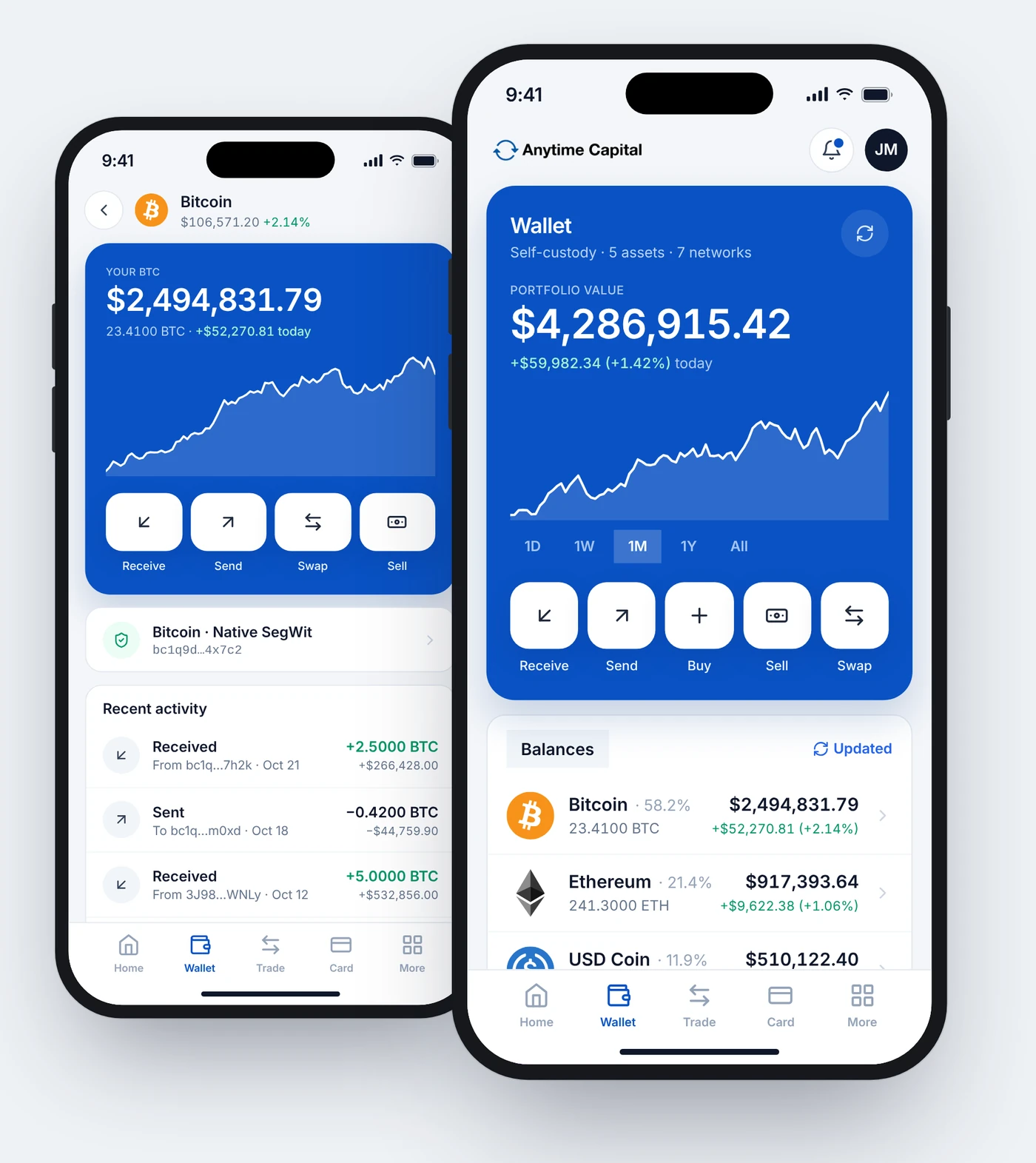
Every Anytime Capital business account includes a free non-custodial business wallet with keys on the holder's own device, so the entity can hold its own keys while using the desk for execution and the account for settlement. Whichever model you choose, write down who can move funds, at what thresholds, with whose approval. Auditors ask; so do acquirers.
| Model | Control | Main risk | Controls to document |
|---|---|---|---|
| Platform custody | The platform holds keys | Counterparty and access risk | Account access, platform due diligence |
| Company self-custody | The company holds keys | Key loss or a single point of failure | Key holders, recovery test, succession |
| Institutional custodian | A third-party custodian | Custodian risk and fees | Custody agreement, withdrawal approvals |
| Hybrid | Split by balance | Two systems to reconcile | Thresholds for moving between them |
Decision three: how is crypto accounted for?
US GAAP changed meaningfully here. FASB's ASU 2023-08 requires fair-value measurement for in-scope crypto assets, for fiscal years beginning after December 15, 2024: holdings mark to market each period, with gains and losses in net income. It replaced the old regime, under which crypto was an indefinite-lived intangible asset — companies wrote down dips as impairments but couldn't write recoveries back up until they sold.
The standard also asks for more disclosure: significant holdings by name, cost basis, fair value and units held, any contractual sale restrictions, and an annual reconciliation of activity — additions, dispositions and gains and losses. Scope matters. It covers fungible crypto assets that give the holder no enforceable claim on underlying assets; tokens that do, such as most redeemable fiat-backed stablecoins, generally fall outside it and are accounted for under other guidance.
| Before (impairment model) | After (fair value, ASU 2023-08) | |
|---|---|---|
| Measurement | Cost less impairment | Fair value each reporting period |
| When the price rises | Nothing recognized until sale | Gain in net income |
| When the price falls | Impairment loss, never reversed | Loss in net income |
| Balance-sheet presentation | Within intangible assets | Separate from other intangibles |
| Disclosure | Limited | Significant holdings, restrictions, annual rollforward |
How are stablecoins treated on the balance sheet?
Mostly outside the crypto standard, because a redeemable stablecoin gives the holder a claim on the issuer's reserves. Each token has to be evaluated on its terms, and today companies agree a classification with their auditors. That is moving: on August 18, 2026, FASB proposed guidance on when a stablecoin can be presented as a cash equivalent — broadly, a direct, on-demand right to redeem with the issuer for a known cash amount, backed one-to-one by short-term, highly liquid reserves — with comments due November 19, 2026.
Operationally, stablecoins fit a treasury as working capital rather than investment: dollar-denominated balances for payment operations, without the volatility question. They still aren't bank deposits and aren't FDIC-insured. The GENIUS Act, signed July 18, 2025, created a federal framework for payment stablecoin issuers, but issuer, reserve and structure risk remain real, so policies typically cap balances per issuer.
Decision four: the policy the board approves
The one-page treasury policy that makes everything else defensible covers: which assets are eligible (commonly BTC, ETH and stablecoins), maximum position size as a share of reserves, who executes and who approves, the custody arrangement, and when rebalancing or liquidation triggers. Sized deliberately and documented, a crypto position reads like any other treasury allocation. Improvised, it reads like a finding.
- Eligible assets, and any per-asset or per-issuer caps
- Maximum allocation relative to total reserves, after operating runway
- Execution authority and approval thresholds, by role
- Custody model, key holders and the recovery procedure
- Liquidation and rebalancing triggers, and who can invoke them
- Reporting: what the board sees, and how often
What controls do auditors and acquirers ask about?
Three questions come up every time: does the asset exist, does the company control it, and who could move it without anyone else knowing. Existence and control are shown with wallet addresses and balances that reconcile to the books, and — for self-custody — evidence that the company can sign from those addresses, such as a signed message or a small test transaction. Segregation of duties answers the third: the person who approves a movement shouldn't be the only person who can make it.
Map the policy onto the platform's permissions. On a standard Anytime Capital business account, the account owner places crypto buys and sells and holds the business wallet; admins, members, accountants and viewers see activity at their own level, and an outside CPA can be given the read-only Accountant role. Ownership moves only by transfer to an existing admin, so the succession plan names that admin. Companies that need several approvers per movement use enterprise accounts, which add role-based permissions, multi-step approvals on what leaves the account, and a full audit trail.
A month in a corporate crypto treasury
- 1
Policy check
Is the trade inside the approved assets, size and authority?
Before trading - 2
Execute
Routine sizes on order flow; blocks on a firm desk quote.
Recorded in USD - 3
Custody
Coins moved to the approved wallet, holders documented.
Keys controlled - 4
Reconcile
On-chain balances matched to the books and statements.
Monthly - 5
Mark and report
Fair-value change booked; holdings reported to the board.
Period end
How much crypto should a company hold?
There's no standard number, but there is a standard method. Start from cash needs: operating runway, payroll and committed spending stay in dollars. Size any volatile allocation from what's left, and stress-test it: bitcoin has fallen more than 70% from a peak more than once, in 2018 and again in 2022, so the policy should state what the company does if the position halves — hold, rebalance or sell — before it happens. Operating companies with crypto exposure commonly hold single-digit percentages of reserves; crypto-native and conviction-led companies range far higher. The defensible number is the one the board approved in writing beforehand.
Exit capacity belongs in the sizing too. A position you could only sell slowly, or only on a thin book, is larger in risk terms than its market value suggests — which is why treasuries holding size keep a desk relationship and a same-day path back to dollars. On Anytime Capital, sales settle to the business's own bank account the same day by ACH, Fedwire or RTP.
How do tax and the books diverge?
Tax stays on its own track. Buying and holding isn't taxable under current US federal rules; disposals — sales, swaps, payments — recognize gain or loss against tax basis. Books, under fair value, recognize changes every period. The two will diverge from one quarter to the next, creating deferred tax for companies that account for it, and your accountant will manage that with records rather than heroics.
The largest groups have one more point to watch. The corporate alternative minimum tax applies to groups averaging more than $1 billion a year of adjusted financial statement income, which fair value would otherwise swell with unrealized gains; interim IRS guidance issued on September 30, 2025 lets companies disregard unrealized gains and losses on digital assets held at fair value for that calculation. General information, not tax advice.
On Anytime Capital
FedNow, RTP, Fedwire and ACH in one business account
Pick the rail per payment instead of per bank: instant when it has to land now, a wire when the counterparty insists, ACH when it can wait, and local rails or stablecoins when it crosses a border. Sign up online in minutes.
- RTP & FedNowSeconds, any day
- WireSame day
- ACH to vendorsSame day or next day
- 71+ countriesMinutes to same day
- USDC & USDTMinutes, including weekends
Business account
Send and receive on every US rail
US account and routing numbers in your business's own name. Get paid by FedNow, RTP, wire or ACH, and pay the same ways, with every movement in one ledger.
Enterprise treasury
Operating accounts, approvals, API
Operating accounts and sub-accounts, approval rules and an audit trail, plus an API and signed webhooks for moving money from your own systems.
Personal
A cash account with a debit card
A cash account and card with early direct deposit and crypto built in, opened online in minutes, with no minimum balance.
Frequently Asked Questions
What share of reserves do companies typically allocate?
Operating companies with crypto exposure commonly hold single-digit percentages of reserves, while crypto-native and conviction-led companies range far higher. The defensible number is the one your board approved in writing beforehand.
Do we need a qualified custodian like a fund does?
Operating companies generally aren't required to use one — that obligation attaches to registered investment vehicles and advisers. Many still choose institutional custody or disciplined, documented self-custody for governance reasons.
How do stablecoins fit a treasury?
As working capital rather than investment: dollar-denominated balances for payment operations, held without the volatility question. They aren't bank deposits and aren't FDIC-insured — treat issuer and structure risk as real, and cap balances per issuer.
What changed with the 2025 accounting rules?
Fair-value treatment: in-scope crypto now marks to market through net income each period, both directions, with more disclosure. The old impairment-only model — write down dips, never write up recoveries — is gone for fiscal years beginning after December 15, 2024.
How do we prove to auditors that we control the wallet?
Reconcile on-chain balances at your published addresses to the books, and show you can sign from them — a signed message or a small test transaction. Pair that with documented key holders and approval rules.
What happens if the person holding the keys leaves?
That's what the succession plan is for: documented recovery, more than one person able to act, and — on an Anytime Capital business account — an existing admin who can take over ownership by transfer. Test recovery before you need it.
Can a subsidiary hold the crypto instead of the parent?
Yes, and many groups prefer it. The holding entity is verified and titled in its own name, keeps its own records, and its position consolidates into group accounts. Decide it in the policy, before the first purchase.
Keep reading
Important Disclosures
- Cryptocurrencies and stablecoins are not FDIC-insured deposits, are not bank guaranteed, and can involve risk, including possible loss of value.
- Cryptocurrency transactions are irreversible once confirmed. Verify all details before sending.
- Additional identity verification may be required depending on transaction type and amount.
- Third-party fees, timings, and product details cited on this page are industry-typical figures as of the date shown and may have changed. Verify current details with the relevant institution.
- Anytime Capital is a licensed money services business. Information on this page is educational and is not financial, legal, or tax advice.
- Anytime Capital is a fintech company, not a bank. Banking services are provided by our licensed banking partners. Stablecoins and other digital assets are not bank deposits, are not FDIC-insured and may lose value.