Complete guide
What is a stablecoin?
Quick answer
A stablecoin is a digital token designed to hold a fixed value — almost always $1.00 — backed by reserves such as cash and short-term US Treasuries held against every token issued. Under the GENIUS Act of 2025, US payment stablecoin issuers must hold 1:1 reserves and publish monthly disclosures.
Updated October 2026. Evergreen page — refreshed in place as facts change.
- Target value
- $1.00
- Per token, for dollar stablecoins
- All stablecoins
- $250B+
- Total supply, 2026 (industry trackers)
- USDT
- $150B+
- Largest stablecoin, 2026
- USDC
- $60B+
- Second-largest, 2026
- GENIUS Act
- July 2025
- Signed; in force by January 2027
- Reserves
- 1:1
- Cash, short T-bills, repos, MMFs
- Settlement
- Minutes
- 24/7/365; seconds on Solana
- Deposit insurance
- None
- Stablecoins are not FDIC-insured deposits
Stablecoins are the part of crypto that behaves like money: a dollar that moves like an email — in minutes, at any hour, to anyone with a wallet — instead of like a bank transfer bound to business days and cutoffs. This guide explains what a stablecoin is, how it holds its value, the different designs and how they have fared under stress, what changed when the US regulated payment stablecoins in 2025, which coins matter in 2026, how a stablecoin payment actually moves from wallet to bank, the risks worth understanding, and where stablecoins genuinely beat bank rails (and where they don't).
Payment methods on this page
.svg)
.svg)
.svg)
What is a stablecoin, in plain English?
A stablecoin is a cryptocurrency engineered not to move in price. One token targets one unit of a reference currency — for the coins that matter commercially, one US dollar. You send and receive it on public blockchains like any crypto asset, but its value stays at a dollar, so it works for payments, invoicing, payroll, and savings in a way that volatile assets like bitcoin cannot.
Think of it as a digital cash claim: the issuer holds a pool of reserve assets, and each token is a claim redeemable against that pool at $1.00. The token moves on-chain; the reserves sit in banks and Treasuries off-chain. Total stablecoin supply has stayed above $250 billion through 2026 by industry trackers' counts, almost all of it pegged to the dollar.
How do stablecoins stay at $1.00?
The major dollar stablecoins are fiat-backed: for every token in circulation, the issuer holds about a dollar of reserves — bank deposits, US Treasury bills, and overnight repurchase agreements. Two mechanisms keep the market price pinned. First, redemption: qualified holders can return tokens to the issuer for dollars, so a price below $1.00 creates a riskless arbitrage that pulls it back. Second, issuance: new tokens are only created when someone deposits dollars, so supply mirrors reserves.
A smaller family is crypto-collateralized (DAI/USDS is the long-running example), backed by an over-collateralized pool of crypto assets rather than bank reserves. And the cautionary tale is the algorithmic model — TerraUSD, which held its peg with an incentive mechanism instead of assets and collapsed in May 2022, erasing roughly $40 billion. US law now effectively excludes that model from the regulated payment-stablecoin category.
How a fiat-backed stablecoin is minted and redeemed
- 1
Dollars in
A verified customer wires dollars to the issuer.
Bank rail - 2
Tokens minted
The issuer creates the same number of tokens and sends them out.
One per dollar - 3
Tokens circulate
They move wallet to wallet on public blockchains, any hour.
Minutes - 4
Holder redeems
A verified customer returns tokens to the issuer.
On demand - 5
Burned, paid out
The tokens are destroyed and dollars leave the reserve.
Supply shrinks
What types of stablecoins are there?
'Stablecoin' covers several designs with very different risk profiles. The label on the token tells you the target; the design tells you what stands behind it:
| Type | Backed by | Examples | Track record |
|---|---|---|---|
| Fiat-backed | Cash, short-term Treasuries, repos held by the issuer | USDT, USDC, PYUSD, RLUSD | Brief dips under stress; recovered as redemptions worked |
| Crypto-collateralized | More crypto than the coins issued, locked on-chain | DAI / USDS | Held up, but followed USDC down in March 2023 |
| Synthetic (hedged) | Crypto plus offsetting derivatives positions | USDe | Newer design; depends on derivatives markets |
| Algorithmic | An incentive mechanism, little or no collateral | TerraUSD (UST) | Collapsed in May 2022 |
| Commodity-backed | Gold or another commodity | PAXG, XAUT | Tracks the commodity, not $1.00 |
| Other fiat currencies | Euro or other reserves | EURC | Smaller; growing under the EU's MiCA rules |
What did the GENIUS Act change in 2025?
The GENIUS Act, signed on July 18, 2025, gave the US its first federal framework for payment stablecoins. It takes effect on the earlier of January 18, 2027 or 120 days after regulators issue final implementing rules, which they were still finalizing through 2026. The essentials:
- Only permitted issuers — subsidiaries of insured banks, federally qualified nonbank issuers, and state-qualified issuers under certified state regimes — may issue payment stablecoins in the US.
- Reserves must back tokens 1:1 in specific assets: US currency, bank demand deposits, Treasury bills, notes or bonds maturing in 93 days or less, Treasury-backed repos, and government money market funds.
- Issuers publish their reserve composition monthly, examined by a registered public accounting firm and certified by the CEO and CFO; large non-public issuers (over $50 billion outstanding) also file audited annual financial statements.
- Issuers may not pay interest or yield to holders on the stablecoin itself, and may not suggest it is federally insured or government-backed.
- Holders' claims on reserves take priority if an issuer fails.
- Three years after enactment, US platforms may offer only payment stablecoins from permitted issuers, with limited exceptions for issuers under comparable foreign regimes.
What are the major stablecoins in 2026?
Two coins dominate commercial use — together they account for the large majority of all stablecoin supply — with a longer tail behind them:
| Coin | Issuer | Scale & profile | Reserve reporting |
|---|---|---|---|
| USDT (Tether) | Tether (headquartered in El Salvador since 2025) | The largest stablecoin — above $150 billion in 2026, more than half of all supply; deepest liquidity, dominant outside the US | Quarterly attestations |
| USDC | Circle (US public company since its 2025 NYSE listing) | Second-largest — above $60 billion in 2026; preferred where US regulatory clarity matters | Monthly attestations |
| PYUSD | Paxos for PayPal | Payments-focused, integrated into PayPal/Venmo | Monthly attestations |
| RLUSD | Ripple (NY trust charter; launched December 2024) | Enterprise and settlement focus | Monthly attestations |
| USDS / DAI | Sky (decentralized protocol) | Crypto-collateralized rather than fiat-backed | On-chain collateral, publicly inspectable |
How does a stablecoin payment actually move?
Sending a stablecoin is sending a token on a specific blockchain. You choose the coin, the network and the recipient's address on that network; the network confirms the transfer, typically in seconds to minutes; and the recipient either holds the tokens or sells them for dollars at a regulated off-ramp that pays their bank. There is no correspondent bank in the middle and no cutoff time, and the network fee is paid in the network's own coin — ether on Ethereum, SOL on Solana, TRX on Tron.
The same coin on different networks is the same dollar on different rails. USDT on Tron and USDT on Ethereum are both USDT, but an address on one is not an address on the other, and tokens sent to the wrong network can be unrecoverable. The network is the part people get wrong:
| Network | Address looks like | Fee paid in | Typical confirmation | Common coins |
|---|---|---|---|---|
| Ethereum | 0x followed by 40 hex characters | ETH | A few minutes | USDT, USDC and most others |
| Solana | 32–44 letters and digits | SOL | Seconds | USDT, USDC |
| Tron | 34 characters starting with T | TRX | About a minute | USDT |
A stablecoin payment, wallet to bank
- 1
Hold or buy
USDC or USDT in a wallet, bought at a regulated on-ramp if needed.
Your wallet - 2
Send on-chain
To the recipient's address on the network they asked for.
You choose - 3
Network confirms
The transfer is final once confirmed on-chain.
Seconds to minutes - 4
Recipient holds
Keeps the dollars on-chain, or pays someone else with them.
Any hour - 5
Bank payout
Sells for dollars paid to an account in their name.
Payout rail
What are stablecoins actually used for?
The real-world uses in 2026, roughly in order of volume:
- Trading and settlement — the cash leg of crypto markets runs on stablecoins.
- Cross-border transfers — minutes and cents instead of correspondent-bank days and fees; see our stablecoin vs wire comparison for the honest math.
- Dollar access — in high-inflation economies, a phone wallet holding digital dollars is a savings account the local banking system can't offer.
- Business payments and payroll — paying international contractors without wire fees or cutoff times.
- Treasury operations — moving value between entities and exchanges 24/7, including weekends and bank holidays.
- Payment settlement — card networks and payment processors added stablecoin settlement for merchants and partners through 2025–2026.
Can a stablecoin lose its peg?
Yes — briefly and instructively, even for the well-run ones. In March 2023, USDC traded near $0.87 for a weekend after Circle disclosed $3.3 billion of reserves at the failed Silicon Valley Bank; it recovered to $1.00 within days once regulators backstopped the bank's deposits. USDT has dipped a few cents below the peg in stressed markets, notably May 2022, and recovered as redemptions did their work. TerraUSD, with no real reserves, went to effectively zero in the same month.
The lesson is not 'stablecoins break'; it is that a stablecoin is exactly as good as its reserves and its redemption mechanism. Fiat-backed coins with liquid, disclosed reserves have consistently snapped back; designs without them have not. Stablecoins are not FDIC-insured deposits — the reserve disclosures are the thing to read.
| When | Coin | Low | Cause | Outcome |
|---|---|---|---|---|
| May 2022 | TerraUSD (UST) | Effectively zero | Algorithmic design with no real reserves | Never recovered; roughly $40 billion lost |
| May 2022 | USDT | About $0.95 | Panic after Terra's collapse | Back to $1.00 within days as redemptions were paid |
| March 2023 | USDC | About $0.87 | $3.3 billion of reserves at the failed Silicon Valley Bank | Back to $1.00 after deposits were guaranteed |
| March 2023 | DAI | About $0.90 | Heavy USDC collateral | Recovered with USDC |
What are the risks of holding stablecoins?
Price is the risk stablecoins are designed away from; the others remain, and they are worth naming before holding size:
- Issuer and reserve risk — the coin is only as good as what backs it and where that is held, as the 2023 bank failure showed.
- Redemption access — direct redemption is usually open only to the issuer's verified customers, often above a high minimum; everyone else exits through a platform or market.
- Freeze risk — centralized issuers can and do freeze tokens at specific addresses for sanctions and law-enforcement reasons.
- Network and wallet risk — the wrong network, a lost recovery phrase, or a look-alike 'poisoned' address in your history can lose funds permanently.
- Platform risk — on a custodial platform you hold a claim on the platform, not the token itself.
- Regulatory change — rules in the US and abroad were still being finalized in 2026, and coins from non-permitted issuers may be restricted.
- No deposit insurance — stablecoins are not bank deposits and are not FDIC-insured.
Do stablecoins pay interest?
The token itself does not — and under the GENIUS Act, US-regulated payment stablecoin issuers are prohibited from paying holders yield on the stablecoin. Yield offers you see in the market come from somewhere else: lending programs, DeFi protocols, or tokenized money-market funds, each with its own risk and regulatory profile distinct from simply holding the coin. Treat 'earn on your stablecoins' as a separate product with separate risks, because it is.
How do stablecoin issuers make money?
Mostly from the interest on their reserves. An issuer holding tens of billions of dollars in Treasury bills and repos earns the yield on those assets while paying holders nothing on the token — under the GENIUS Act it is not allowed to — so when interest rates are positive, reserve income is the business model. Issuers also charge fees on direct minting and redemption for large customers, and some share reserve income with the exchanges and payment companies that distribute their coin.
That structure explains two things worth knowing. Issuers want reserves in short, liquid government paper because it earns and it can be sold quickly if many holders redeem at once. And any 'yield on stablecoins' you are offered comes from a platform or protocol doing something with your coins, not from the token itself.
How do stablecoins compare to bank rails?
Speed and availability are the headline: a stablecoin transfer settles in minutes, any hour of any day, for network fees usually under a few dollars — while wires settle in hours on business days for $25–$50, and ACH takes 1–3 business days. The trade-offs are real too: the recipient must be able to receive and off-ramp digital assets, and both endpoints still carry know-your-customer obligations at regulated on/off-ramps.
We run both rails at Anytime Capital, so the comparison page pulls no punches in either direction: stablecoin vs wire transfer for large payments.
| Rail | Typical speed | Hours | Typical sender cost | Reversible? |
|---|---|---|---|---|
| USDC / USDT | Seconds to minutes | 24/7/365 | Network fee, cents to a few dollars | No — final on-chain |
| FedNow / RTP | Seconds | 24/7/365 | Set by each bank | No — final |
| Domestic wire | Same business day | Business days, before cutoff | $25–$35 | No — final once settled |
| ACH | 1–3 business days | Business days | Often free for consumers | Returnable in defined cases |
| International wire | 1–5 business days | Business days | $35–$50, plus intermediary and FX costs | Recall is only a request |
How do you hold and send stablecoins?
Two custody models. On an exchange or platform, the service holds the keys — convenient, but you hold a claim on the platform rather than the asset. In a non-custodial wallet, you hold the keys and the tokens are yours on-chain; the responsibility for securing the recovery phrase is yours too.
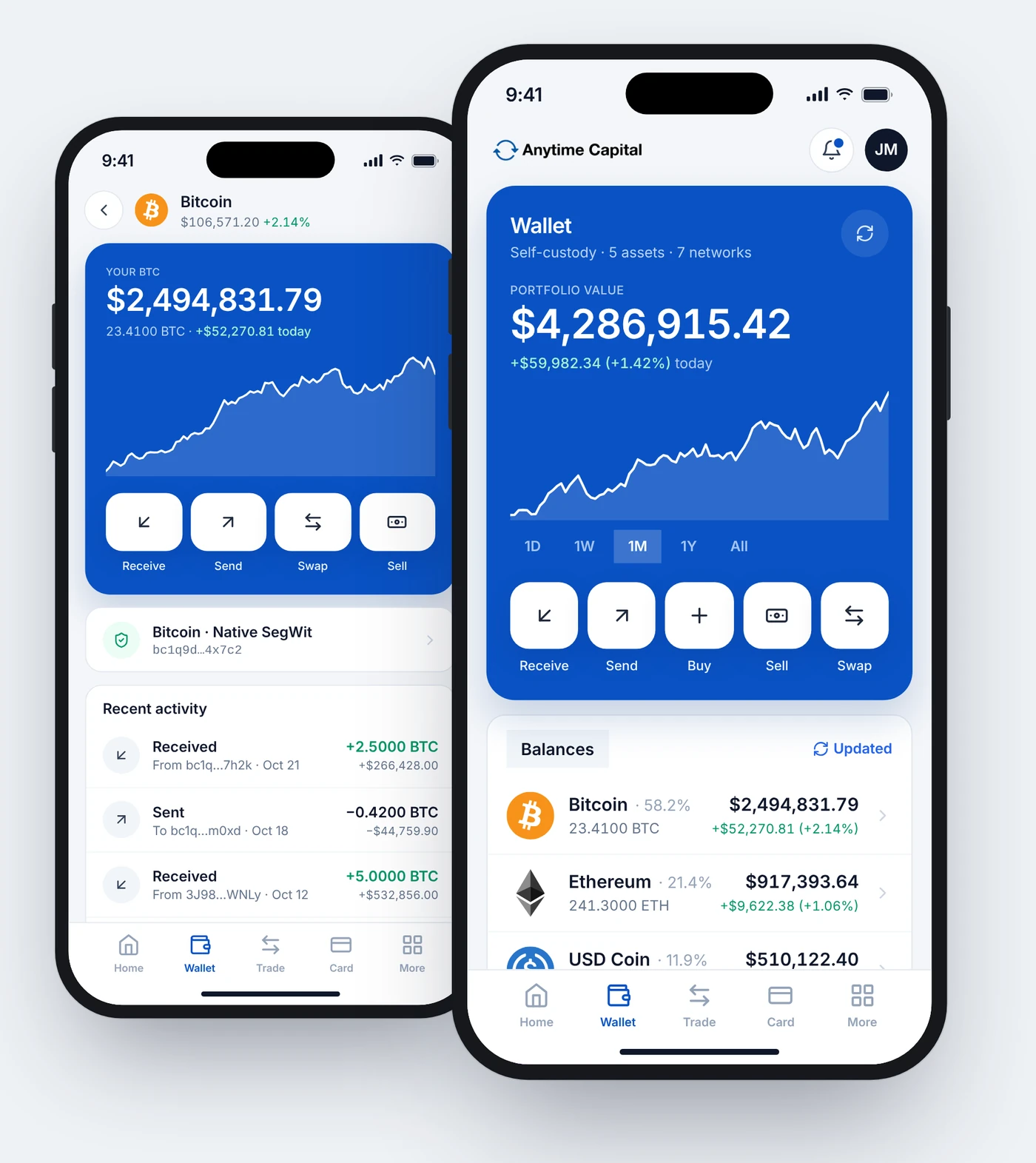
An Anytime Capital account pairs a cash account with a non-custodial wallet supporting USDT and USDC (alongside BTC, ETH, SOL, LTC and TRX) — you hold your own keys, and buying and selling happen in the same app, with sales paid out to a bank account in your name. One practical note whichever route you choose: a stablecoin lives on a specific network (USDT on Tron is not the same rail as USDT on Ethereum), and tokens sent on the wrong network can be unrecoverable. Match the network to what your recipient can receive, every time.
Frequently Asked Questions
Is a stablecoin the same as a CBDC?
No. A central bank digital currency would be issued by the central bank itself; stablecoins are issued by private companies holding reserves. The US has no retail CBDC — as of 2026, dollar stablecoins under the GENIUS Act framework are the regulated private-sector version of a digital dollar.
Are stablecoins safe to hold?
Fiat-backed stablecoins from regulated issuers with disclosed, liquid reserves have held their pegs through real stress, but they are not risk-free and they are not FDIC-insured deposits. Issuer quality, reserve composition, and the network you hold them on are the risks to understand before holding size.
Which stablecoin is the biggest?
USDT (Tether) is the largest by circulating supply — above $150 billion in 2026 — with USDC the second-largest. USDT dominates global trading liquidity; USDC is often preferred by US businesses for its issuer's regulatory posture.
Can I spend stablecoins like regular money?
Increasingly, yes — payment processors and card networks added stablecoin settlement through 2025–2026 — but everyday acceptance still usually means converting to dollars first. On Anytime Capital you can sell stablecoins and have the dollars paid to a bank account in your name.
What's the difference between USDT and USDC?
Both target $1.00. USDT is larger and more liquid globally, with quarterly attestations; USDC is issued by US-based Circle with monthly attestations and a more US-regulatory-forward posture. Our USDT vs USDC comparison covers reserves, history, and when to use each.
Do I pay taxes on stablecoins?
In the US, disposing of a stablecoin — selling or spending it — is a reportable event like any crypto disposal, though gains or losses on a dollar-pegged token are typically minimal. Brokers report sales on Form 1099-DA starting with 2025. This is general information, not tax advice; consult a tax professional.
Who can redeem stablecoins directly for dollars?
Usually only the issuer's verified customers — typically businesses and institutions, often above a minimum amount. Individuals normally sell stablecoins on a regulated platform instead, which pays the dollars to their bank.
Can a stablecoin issuer freeze my tokens?
Centralized issuers such as Tether and Circle can freeze tokens at specific addresses, and do so for sanctions and law-enforcement reasons. It is rare for ordinary users, but it is a real difference from cash and from decentralized crypto assets.
Keep reading
Important Disclosures
- Cryptocurrencies and stablecoins are not FDIC-insured deposits, are not bank guaranteed, and can involve risk, including possible loss of value.
- Cryptocurrency transactions are irreversible once confirmed. Verify all details before sending.
- Additional identity verification may be required depending on transaction type and amount.
- Third-party fees, timings, and product details cited on this page are industry-typical figures as of the date shown and may have changed. Verify current details with the relevant institution.
- Anytime Capital is a licensed money services business. Information on this page is educational and is not financial, legal, or tax advice.