Answer
What is an OTC desk?
Quick answer
An OTC (over-the-counter) desk executes large crypto trades directly between the buyer and the desk at one privately quoted price, instead of routing the order through a public exchange order book. The trade fills entirely at the agreed number — no slippage, no partial fills, and no visible market footprint.
Updated October 2026. Evergreen page — refreshed in place as facts change.
- Price
- One firm quote
- For the full size, all or nothing
- Market footprint
- None
- Never shown on a public order book
- Assets quoted
- 38+
- Two-way at Anytime Capital; sells on 20+
- Dollars back
- Same day
- By ACH, Fedwire or RTP
- Wire deadline
- 6:45 p.m. ET
- Fedwire customer cutoff; banks set earlier
- RTP
- 24/7
- Seconds; up to $10M per payment
- Travel rule
- $3,000
- Transfer data shared at or above (FinCEN)
- Verification
- KYB
- Same rules as any exchange
What is an OTC desk, in practice? It is the off-exchange lane every market with size develops — equities have block desks, bonds trade almost entirely dealer-to-dealer — and crypto is no different. Instead of sending a large order into a public order book and watching it move the price, a business asks the desk for a price on the whole amount, gets one firm number back, and trades at it.
This page covers the problem the desk solves, how a desk trade runs from request to settlement, principal and agency desks, when to use the desk instead of the book, how the dollar leg settles and how fast, what OTC trades really cost, what to look for in a desk, and the compliance checks that come with size.
Payment methods on this page
.svg)
.svg)
.svg)
.svg)
What problem does an OTC desk solve?
A public order book shows liquidity in layers: some depth at each price. A large market order eats through layer after layer, filling worse as it goes — that's slippage. Working the order slowly instead telegraphs your intent to every algorithm watching, and the market drifts away from you before you finish. Either way, size pays a tax for being visible.
The OTC desk removes the visibility. You ask for a price on the whole amount; the desk — which sources liquidity across venues and its own inventory — returns one firm, executable quote. Accept, and the entire block trades at that number.
| Route | What you see first | What you get | Visible to the market? |
|---|---|---|---|
| Market order on an exchange | The best price on the screen | An average across every level it consumed | Yes, instantly |
| Limit orders worked over hours | Your own price | Partial fills, or a market that moves away | Yes, as each order rests |
| Desk quote (OTC) | One price for the full size | Exactly that price, for all of it | No |
How does an OTC trade work, step by step?
The flow is shorter than most expect: tell the desk the asset, size and direction; receive a quote, live for a short window; accept or pass; settle. Settlement means the crypto and the dollars change hands. On a platform-integrated desk like ours both legs move inside the same account relationship: on a buy, the business places the order and funds it by wire or RTP with the order's reference, and the coins are delivered to the business wallet; on a sale, the dollars go to the business's own bank account the same day.
After a first trade, the relationship is conversational: a message with size and side, a number back, done. Tell the desk in advance about unusual size or a deadline, so liquidity and settlement are lined up before you ask for the price.
An OTC block trade, request to settlement
- 1
Request
Asset, size and side — buy or sell — sent to the desk.
Message or call - 2
Quote
One firm, all-in price for the full size.
Short window - 3
Accept
Agree the price and the trade is locked.
No partial fills - 4
Settle crypto
Coins delivered to, or sent from, the business wallet.
On-chain - 5
Settle dollars
Funds in by wire or RTP; proceeds out the same day.
ACH, Fedwire, RTP
Principal or agency: who is on the other side of the trade?
Desks work in one of two ways, and it changes what the quote means. A principal desk trades with you directly, from its own inventory and the liquidity it can source, and quotes a firm all-in price: its compensation is the spread inside that price, and it carries the risk of the market moving after you accept. An agency desk works your order across venues on your behalf and charges a commission, so your final price depends on how well the order is worked.
For a business that wants a known number before it commits, a principal quote is usually the cleaner tool. Whichever model a desk uses, ask it to say so plainly, and ask whether a quote is firm or indicative before you accept anything.
| Principal desk | Agency desk | |
|---|---|---|
| Who you trade with | The desk itself | The market, through the desk |
| Price | Firm, known before you accept | Depends on execution |
| Compensation | Spread built into the quote | Commission on top |
| Market risk after acceptance | The desk's | Yours until the order is filled |
When should a business use the desk instead of the order book?
The honest threshold is liquidity-relative, not a fixed dollar figure: an order that would consume a meaningful share of the visible book belongs on the desk. In deep pairs like BTC/USD that might mean six figures; in a thinner asset it can be much less. If the screen's depth chart makes you hesitate, that's the signal.
Below the threshold, standard order flow is perfectly good — desks add value on size, privacy and settlement, not on a $2,000 purchase.
| Situation | Use | Why |
|---|---|---|
| Routine purchase in BTC, ETH or a stablecoin | Order flow | Deep books absorb it at market |
| Treasury allocation after a board vote | Desk | One price for the full amount, privately |
| Unwinding a position into dollars | Desk | Two-way quote, then same-day settlement |
| Large order in a thinner altcoin | Desk | Visible depth may vanish under the order |
| Rebalancing between two assets | Desk | One quote for the pair instead of two market orders |
How is an OTC trade settled, and how fast are the dollars?
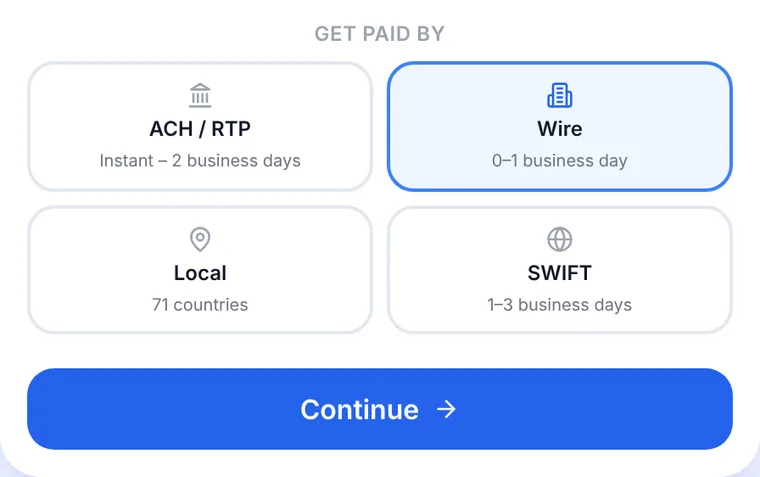
The crypto leg moves on any day of the week: coins arrive on-chain in minutes on most networks, longer where several bitcoin confirmations are wanted. The dollar leg follows the banking rails. Fedwire runs on business days, from 9:00 p.m. ET the evening before to 7:00 p.m., with a 6:45 p.m. deadline for customer wires, and your bank's own cutoff is earlier. RTP settles in seconds, every day of the year, up to $10 million per payment at the network level. ACH is fine when timing is loose.
At Anytime Capital, sales settle back to dollars the same day by ACH, Fedwire or RTP, and proceeds pay out only to a bank account in the business's name. A confirmed sale in the morning can be operating cash by the afternoon; a sale late on a Friday wants RTP if your bank supports it, or it waits for Monday's wire window.
What does an OTC trade cost?
At a principal desk there's usually no separate commission: the cost is the spread between the quote and the market's mid-price. That makes the sticker look wider than an exchange's posted fee — and it is the wrong comparison. The right test is the all-in price on your size: the desk quote against what the same order would actually have filled at on the book, slippage included.
Add the costs that sit outside the trade — a bank's outgoing wire fee, network fees on withdrawals — and compare like with like. Our own pricing is published on the fees and limits page, the only place we quote it.
What should you look for in an OTC desk?
Separate desks on the things that decide your outcome, not on the pitch. A desk eager to sell to you but slow to bid your exits is half a product, and a great quote with a slow dollar leg is a worse trade than it looks:
- Quoting competitiveness — compare the all-in quote against the screen for your size
- Two-way appetite — equal willingness to buy from you and sell to you
- Asset coverage — majors only, or everything your treasury might hold
- Settlement rails and timing — same-day dollars by Fedwire or RTP, to an account in your name
- Firm or indicative — whether the quote you accept is the price you get
- Verification and licensing — full KYB, and an entity and license you can check
- A person — a named contact who answers, and somewhere to meet if you want to
What compliance checks apply to large OTC trades?
Size doesn't change the rules; it makes some of them visible. The business is verified once through KYB, and large or unusual trades can bring source-of-funds questions — where the money or the coins came from. Transfers of $3,000 or more between financial institutions carry originator and beneficiary information under FinCEN's travel rule, and cash transactions over $10,000 are reported to FinCEN. Every trade is screened.
None of this is a reason for delay if you plan for it. Answer questions the same day, in plain language, with the document attached, and settlement keeps its timeline. Processing at Anytime Capital is subject to compliance review; our processing times page sets out what to expect by method.
On Anytime Capital
FedNow, RTP, Fedwire and ACH in one business account
Pick the rail per payment instead of per bank: instant when it has to land now, a wire when the counterparty insists, ACH when it can wait, and local rails or stablecoins when it crosses a border. Sign up online in minutes.
- RTP & FedNowSeconds, any day
- WireSame day
- ACH to vendorsSame day or next day
- 71+ countriesMinutes to same day
- USDC & USDTMinutes, including weekends
Business account
Send and receive on every US rail
US account and routing numbers in your business's own name. Get paid by FedNow, RTP, wire or ACH, and pay the same ways, with every movement in one ledger.
Enterprise treasury
Operating accounts, approvals, API
Operating accounts and sub-accounts, approval rules and an audit trail, plus an API and signed webhooks for moving money from your own systems.
Personal
A cash account with a debit card
A cash account and card with early direct deposit and crypto built in, opened online in minutes, with no minimum balance.
Frequently Asked Questions
Is OTC trading legal and regulated?
Yes — in the US, legitimate desks operate inside licensed businesses with the same KYC and KYB obligations as exchanges. OTC describes the execution method, not a regulatory gray zone.
Do desks have minimum trade sizes?
Many set practical minimums where private quoting beats the order book, varying by desk and asset. Ours engages on orders large enough to move a public order book — talk to the desk about your size; standard order flow covers anything smaller.
How do desk prices compare to exchange prices?
Quotes reference prevailing market prices with the desk's spread built in. For size, the all-in cost is routinely better than what the same order would do to an order book — that comparison, not the sticker spread, is the real test.
What does settlement look like on a sale?
You deliver the asset, the desk delivers dollars. Integrated desks settle to your bank the same day by Fedwire or RTP; standalone desks vary. At Anytime Capital, proceeds pay out only to a bank account in the business's name.
Can we trade OTC outside banking hours?
Crypto trades every day, but the dollar leg follows the rails: RTP runs 24/7 where your bank participates, Fedwire only on business days. Plan large trades for weekday banking hours so both legs settle the same day.
Do we have to fund before the trade?
On a buy, the dollars have to arrive before the coins are delivered. At Anytime Capital you place the order, send a wire or RTP with its reference, and the coins go to the business wallet once the funds arrive and clear review.
Can we deal with the desk in person?
Yes. Our branches in Atlanta, Miami and Houston handle larger crypto orders in person, alongside the live US business team on phone, chat and email.
Keep reading
Important Disclosures
- Cryptocurrencies and stablecoins are not FDIC-insured deposits, are not bank guaranteed, and can involve risk, including possible loss of value.
- Cryptocurrency transactions are irreversible once confirmed. Verify all details before sending.
- Additional identity verification may be required depending on transaction type and amount.
- Third-party fees, timings, and product details cited on this page are industry-typical figures as of the date shown and may have changed. Verify current details with the relevant institution.
- Anytime Capital is a licensed money services business. Information on this page is educational and is not financial, legal, or tax advice.
- Anytime Capital is a fintech company, not a bank. Banking services are provided by our licensed banking partners. Stablecoins and other digital assets are not bank deposits, are not FDIC-insured and may lose value.