Comparison
Payment gateway vs payment processor: what's the difference?
Quick answer
A payment gateway is the software that securely captures a customer's card details and sends the authorization request. A payment processor moves that request through the card networks to the customer's bank and back, then helps settle the funds. Most small businesses now buy both together from one provider.
Updated October 2026. Evergreen page — refreshed in place as facts change.
- Authorization
- Seconds
- Checkout to card issuer and back
- Settlement
- 1–2 days
- Business days, in daily batches
- Parties per payment
- 6
- From cardholder to gateway
- Gateway-only plan
- $25/month
- Authorize.net, plus 10¢ a payment (Oct 2026)
- All-in-one setup
- Same day
- Often approved the day you apply
- Own merchant account
- Days–weeks
- Underwriting before the first sale
- Contracts to manage
- 1 or 3
- All-in-one, or gateway + processor + acquirer
- Card data on your servers
- None
- With a hosted or embedded checkout
Payment gateway vs payment processor is a question most businesses only meet when something breaks or a quote arrives with three company names on it. The two do different jobs in the same two seconds: one captures the card, the other moves the payment. This page explains each, the other parties behind them, how they are priced separately and together, and which setup suits which business.
Payment methods on this page






What is the difference between a payment gateway and a payment processor?
The gateway is the front door and the processor is the road. The gateway is the part your customer touches: the checkout form, the pay button or the terminal connection that captures the card and hands the payment over. The processor never meets the customer; it carries that payment through the card networks to the bank that issued the card, brings back the answer, and later moves the money.
| Payment gateway | Payment processor | |
|---|---|---|
| Its job | Captures and secures card details, then submits the payment | Routes the payment through the card networks and settles the money |
| Where it sits | Between your checkout and the processor | Between the gateway and the card networks and acquiring bank |
| Handles full card numbers? | Yes, briefly, then replaces them with tokens | Yes, to route and settle the payment |
| When it fails, you see | Checkout errors; payments cannot be submitted | Declines, late settlement or missing payouts |
| Priced on its own as | A monthly fee plus a per-transaction fee | A markup on interchange and network fees |
| Sold separately by | Gateway companies, such as Authorize.net | Processors and banks, behind a merchant account |
What does a payment gateway do?
A gateway is the online equivalent of the card terminal on a counter. It collects the card details on your checkout page or app, encrypts or tokenises them, and passes the payment request on. It is also what your website or shopping cart actually connects to, through a hosted page, an embedded form or an API.
Some gateways are sold on their own, such as Authorize.net, which is owned by Visa, and connect to whichever processor and merchant account you already have. Most small businesses never buy one separately, because all-in-one providers include it.
What does a payment processor do?
The processor is the messenger between your business and the card system. It sends the authorization request through the card network to the customer's bank, returns the approval or decline in a couple of seconds, and later handles clearing and settlement, the batch process that actually moves the money.
The processor works with an acquiring bank, the bank that sponsors your business into the card networks and holds your card sales before they are paid out. In everyday use, 'processor' often means the whole bundle of processing, acquiring and payouts.
An online card authorization, end to end
- 1
Checkout
The customer enters a card or pays with Apple Pay or Google Pay.
Customer - 2
Gateway
Encrypts the details, swaps them for a token and submits the payment.
Captures - 3
Processor
Formats the request and routes it to the right card network.
Routes - 4
Network
Visa, Mastercard, Amex or Discover passes it to the card's issuer.
Switches - 5
Issuer
Checks funds, limits and fraud signals, then approves or declines.
Decides - 6
Response
The answer travels back the same way to your checkout.
Seconds, round trip
What is tokenization, and who does it?
Tokenization replaces a card number with a stand-in value that is useless if stolen. A gateway tokenizes the card the moment it is captured, so your systems store and reuse the token for refunds, saved cards and subscriptions instead of the number itself. That is what keeps most businesses out of the heavier parts of PCI DSS.
Card networks run a second layer, network tokens, which stand in for the card number across the whole payment chain and stay valid when a bank reissues a card. Apple Pay and Google Pay use them on the device. For a business, the practical results are fewer declines on saved cards after a card is replaced, and less sensitive data to protect. One limit to know before you ever switch provider: gateway tokens belong to the gateway that issued them and do not work anywhere else.
Who else is involved in a card payment?
A single tap or click touches at least six parties. Knowing who does what helps when you read a statement, compare quotes, or chase a payment that has not arrived.
| Party | What it does | Examples |
|---|---|---|
| Cardholder | Pays with a card or wallet | Your customer |
| Issuing bank | Issued the card, approves or declines, earns interchange | The customer's bank or card company |
| Card network | Runs the rails and sets interchange | Visa, Mastercard, American Express, Discover |
| Acquiring bank | Sponsors the business into the networks and settles its sales | The merchant's bank |
| Processor | Routes authorizations and handles clearing and settlement | Often bundled by your provider |
| Gateway | Captures and secures card details online | Authorize.net, or built into all-in-one providers |
ISO, payfac, PSP: what do the other names mean?
Quotes and contracts add a second layer of names for the companies that sell those roles. Knowing which one you are talking to tells you who sets your price, who holds your money and who you call when something goes wrong.
| Name | What it is | Do you deal with it directly? |
|---|---|---|
| ISO (independent sales organization) | A reseller that signs businesses up for an acquirer's merchant accounts | Yes, if someone sold you a merchant account |
| Payment facilitator (payfac) | Holds one master merchant account and boards businesses under it | Yes: it is your all-in-one provider |
| Acquirer processor | Runs authorization and settlement for an acquiring bank | Rarely; it sits behind your provider |
| Payment service provider (PSP) | A broad name for any company that lets a business take payments | Usually, under whichever name it uses |
| Gateway reseller | Sells a gateway account to connect to your existing merchant account | Only if you buy the gateway separately |
How are gateways and processors priced?
Bought separately, each piece has its own fees. Authorize.net's Gateway Only plan, for a business that already has a merchant account, is $25 a month plus 10 cents a transaction and a 10-cent daily batch fee; its All-in-One plan, which bundles a merchant account, is 2.9% + 30¢ plus the same $25 monthly gateway fee (published US pricing, October 2026). At 300 payments a month, the gateway alone comes to about $58: $25, plus $30 in transaction fees, plus about $3 in batch fees, before the merchant account's own interchange-plus markup and monthly fees.
All-in-one providers fold the gateway into one rate, so there is no gateway fee or batch fee to add. Which costs less depends on volume and card mix: at high volume, a thin interchange-plus markup plus a gateway fee can beat a flat rate; at small-business volume, the fixed monthly fees usually tip it the other way. Our interchange guide shows how to compare the two on a real month of your own sales.
Merchant account or payment facilitator?
With a traditional merchant account, your business is underwritten by an acquiring bank and gets its own account, and you usually buy the gateway separately. With a payment facilitator, the provider holds one master merchant account and signs you up as one of its businesses, so onboarding takes minutes and gateway, processing and payouts arrive together. Stripe, Square and PayPal work this way.
The trade-off is control versus convenience. Your own merchant account can come with negotiated interchange-plus pricing at volume, but also applications, monthly fees and sometimes a contract. A facilitator is quicker and simpler, and typically charges one flat rate.
| Own merchant account + gateway | All-in-one provider (payment facilitator) | |
|---|---|---|
| Onboarding | Full underwriting, often days to weeks | Online, often the same day |
| What you manage | Gateway, processor and merchant account, often from different companies | One account and one dashboard |
| Pricing | Often interchange-plus, with monthly fees | Usually one flat published rate |
| Best for | High volume and negotiating power | Most small and growing businesses |
Which setup is right for your business?
Start from how you sell and how much. The cost of a setup is not only its rate but the time it takes to run, and a separate gateway, processor and merchant account means three contracts and three places to look when something breaks.
- Selling online, through links or invoices, without a payments team: an all-in-one provider
- Already running a shopping cart that needs a specific gateway: check which processors it supports first
- Processing large volumes with a finance team that reads statements: get an interchange-plus quote and compare
- Selling mostly at a counter: compare in-person rates and whether you need hardware at all
Where Anytime Capital Payments fits
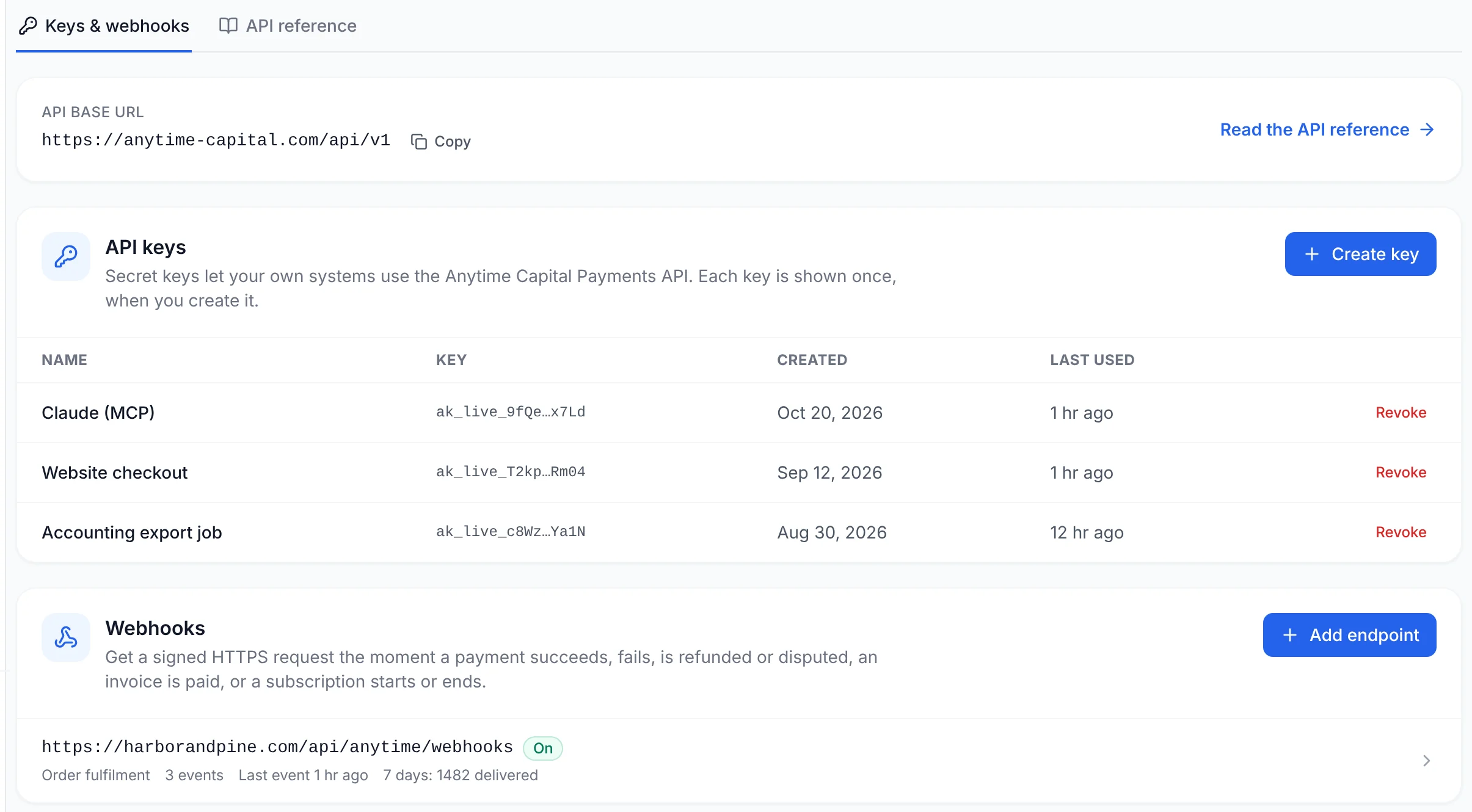
Anytime Capital Payments is the all-in-one model: one sign-up and one dashboard cover checkout, processing, fraud screening and payouts, with processing provided by our licensed partners. Checkout is hosted on your own domain or embedded in your site, and card details are entered on a checkout we serve, so they never pass through your servers.
When you want to automate, the REST API creates payment links, invoices and customers, signed webhooks report every change, and an MCP endpoint lets AI tools create links and invoices with a key you scope. Settled sales sweep instantly into your Anytime Capital business account, 24/7.
Frequently Asked Questions
Do I need both a payment gateway and a payment processor?
You need both functions, but not necessarily two companies. An online payment needs something to capture the card and something to route and settle it. All-in-one providers include both; with a traditional merchant account you often buy the gateway separately.
Is Stripe a payment gateway or a payment processor?
Both, in practice. Stripe provides the gateway (its checkout and API) and handles processing and payouts as a payment facilitator working with acquiring banks, so a business signs up once and gets the whole bundle. Square and PayPal work the same way.
What is a merchant account?
A merchant account is the account at an acquiring bank that receives your card sales before they are paid out to your business bank account. With an all-in-one provider, the provider holds the merchant relationship and you do not apply for one yourself.
Is a payment gateway the same as a POS system?
No. A point-of-sale system runs the sale at a counter: items, prices, taxes and receipts. It connects to a processor, sometimes through a gateway, to take the card payment. Many POS systems now come bundled with their own processing.
What is an acquiring bank?
The acquiring bank, or acquirer, sponsors a business into the card networks, receives its card sales and settles them. Small businesses rarely deal with it directly: the processor or all-in-one provider manages that relationship.
Can I change my payment gateway without changing processor?
With a traditional setup, often yes: a standalone gateway such as Authorize.net connects to many processors and merchant accounts, so one can change without the other, although saved cards stored as gateway tokens have to be migrated. With an all-in-one provider the two come together, so changing one means changing both.
What is a payment service provider (PSP)?
PSP is a broad name for any company that lets a business accept payments, from all-in-one providers such as Stripe, Square and Anytime Capital Payments to companies that offer many local payment methods across countries. What matters is whether a given PSP includes the gateway, processing and payouts, or only some of them.
Keep reading
Important Disclosures
- Third-party fees and product details cited on this page are each company's published US pricing, or industry-typical ranges, as of the date shown and may have changed. Check current pricing with the provider before you decide.
- Information on this page is general and educational — it is not financial, legal, or tax advice.
- Anytime Capital is a fintech company, not a bank. Payment processing, banking and payout services are provided by Anytime Capital's licensed partners. Rates shown are for US card payments; international cards, currency conversion and disputes may carry additional fees shown in your dashboard before you accept a payment.