Answer
How long does an international wire take?
Quick answer
An international wire transfer usually takes 1–5 business days in 2026. Transfers to well-banked corridors often arrive in 1–2 business days, while payments passing through correspondent banks, currency conversion, or extra compliance screening take longer. Cutoff times, time zones, and destination-country controls all affect the clock.
Updated October 2026. Evergreen page — refreshed in place as facts change.
- Typical arrival
- 1–5 days
- Business days, over SWIFT, 2026
- Major corridors
- 1–2 days
- To the euro area, UK, Canada
- To the next bank
- 90%
- Reach the destination bank within an hour, 2024
- To the customer
- 43%
- Credited within an hour, Swift data 2024
- G20 target
- 75% in 1 hour
- Cross-border payments, by end-2027
- Tracking
- UETR
- End-to-end reference on SWIFT payments
- Message format
- ISO 20022
- Swift cross-border since Nov 22, 2025
- Local instant rails
- Seconds
- SEPA Instant, Faster Payments, PIX
How long an international wire takes is no longer mostly about the network. Swift's own 2024 data shows about 90% of cross-border payments reach the destination bank within an hour — but only 43% reach the end customer's account in that time. The days you wait are spent in correspondent queues, compliance screening, time zones and the receiving bank's last mile. This page shows where the time goes, how the clock differs by destination, how to track a payment with its UETR, and when paying over the destination's own instant rail beats a wire outright.
Payment methods on this page





What is the realistic timeline?
Plan on 1–5 business days, and read that range by corridor. Payments between major banks in heavily traded corridors — the US to the UK, the eurozone, Canada — often credit in 1–2 business days, and same-day happens when cutoffs and time zones line up. Transfers to less common destinations, smaller receiving banks, or tightly controlled currencies sit at the slow end.
The days are business days on both calendars: a US federal holiday, the destination's holidays, and differing weekend conventions all pause the clock.
Each source of delay has an owner, which is the useful way to read the range. Some you control completely, some your bank controls, and some come with the destination:
| Factor | Typical delay | Who controls it |
|---|---|---|
| Missed the international cutoff (often around midday ET) | One business day | You: send in the morning |
| Compliance or sanctions review | Hours to a day or more | You, partly: state the purpose and have documents ready |
| Each correspondent hop | Hours, sometimes a day | The banks in the chain |
| Time-zone gap | Up to a business day | Geography: send to Asia early in the US day |
| Destination weekend or holiday | One to two days | The destination's calendar |
| Currency controls or documentation | Days, in some countries | The destination's rules |
| Receiving bank posting | Hours to a day | The recipient's bank |
Why do international wires take longer than domestic ones?
A domestic wire settles once, over Fedwire. An international payment is coordinated over the SWIFT messaging network and may move through one or more correspondent banks, each applying its own processing schedule, cutoff, and compliance screen. Add a currency conversion and a time-zone gap, and a payment that spent minutes 'in flight' can still take two days to credit.
None of that is malfunction — it is the architecture. Which is also why the fastest international wires are the ones submitted early, with complete details, on well-worn corridors. Since Swift's cross-border traffic moved fully to ISO 20022 on November 22, 2025, the payment message itself carries structured names, addresses and remittance data, which cuts the manual repairs that used to stall payments at intermediaries — but it does not remove the hops.
An international wire, hop by hop
- 1
Your bank
Screens the payment and sends a SWIFT message carrying a UETR.
Message out - 2
US correspondent
Holds the dollars that fund the payment and screens it again.
USD leg - 3
Foreign correspondent
Converts the currency, or passes it to the local system.
FX, maybe - 4
Beneficiary bank
Receives the funds and checks the name and account.
Last mile - 5
Recipient
Credited in local currency or dollars, per the instructions.
Credited
What slows an international wire down?
The usual suspects, roughly in order of frequency:
- Compliance and sanctions screening — every cross-border payment is screened, and an unclear purpose or a name similar to a watchlisted party routes the wire to human review. Routine, but it costs a day or more.
- Incomplete or mismatched details — a beneficiary name that does not match the account, a missing IBAN, a wrong SWIFT code. These end in delay at best, a returned wire (minus intermediary fees) at worst.
- Correspondent-bank hops — each intermediary adds processing time, and its own cutoff.
- Currency conversion and controls — exotic currencies add conversion steps, and some destinations impose documentation requirements before crediting.
- Calendars — weekends and holidays on either end, plus the destination's banking hours.
How do time zones affect an international wire?
More than most people expect, because the receiving bank has to be open to credit the payment. A wire released at 2 p.m. in New York reaches a Singapore bank at 3 a.m. local time and a Frankfurt bank after it has closed for the day; both credit it the next local business morning. Asia's next business day starts while New York is having dinner, so a Thursday-afternoon US wire to Singapore commonly credits on Friday there — but one sent Friday afternoon waits for Monday in Singapore, which is Sunday evening in New York.
The practical rule: send to Europe in the US morning, while European banks are still open, and send to Asia as early in the US day as your bank's international cutoff allows, so the payment is waiting when the destination opens.
Banking hours around the world, in Eastern time
New York
Your bank's wire desk
Mexico City
1 hour behind
London
5 hours ahead
Frankfurt
6 hours ahead
Mumbai
10½ hours ahead
Singapore
13 hours ahead
How do you track an international wire?
Ask the sending bank for the payment's UETR — the unique end-to-end reference every SWIFT payment carries. With SWIFT gpi tracking, which most major banks support in 2026, the sending bank can see which institution holds the payment right now and whether it has been credited. That turns 'it should be there soon' into an answer.
If a wire has blown past day five, request a formal trace with the UETR. Traces locate payments definitively, and a payment sitting on a compliance question starts moving once the question is answered — so respond quickly if your bank calls to ask about the transfer.
- In progress — the payment is moving through the chain; the tracker shows which bank last handled it and when.
- Credited — the beneficiary bank reports the funds as credited to the recipient's account, with a timestamp.
- Pending at a bank — usually a compliance question or a detail being repaired; ask your bank which one.
- Rejected or returned — the funds are coming back, minus deductions; the reason code says why.
How do you make an international wire arrive faster?
What actually moves the needle:
- Submit in the morning, before the international cutoff — usually earlier than the domestic one.
- Get the details from the recipient in writing: exact account name, IBAN or account number, SWIFT/BIC, and the receiving bank's name. Verify through a channel you trust.
- State the payment purpose plainly and have documentation ready for large amounts — pre-answering the compliance question is the single best accelerator.
- For recurring corridors, reuse verified beneficiary details rather than re-keying them each time.
- Include the recipient's full street address and, where the destination requires one, a payment purpose code — missing fields are what intermediaries stop to repair.
- Check the destination's calendar for holidays and its weekend before promising a date.
Is it faster to pay over a local rail than by SWIFT?
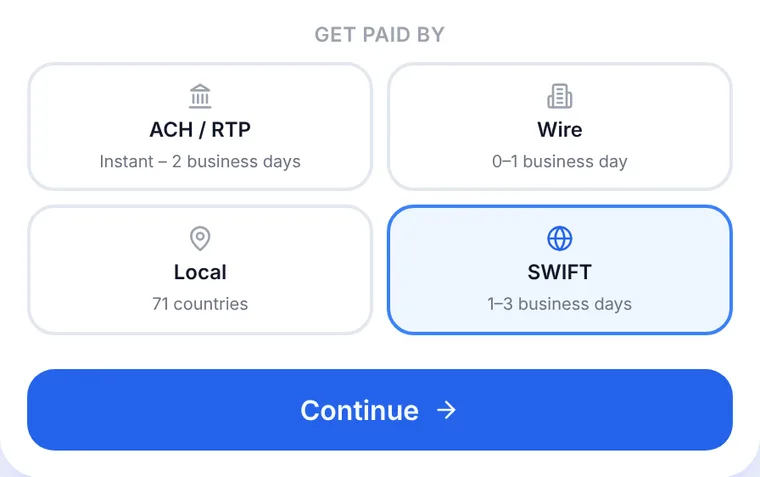
For many countries, much faster. A supplier in the euro area, the UK, Brazil, Mexico or India can be paid over their own country's instant system — SEPA Instant, Faster Payments, PIX, SPEI or UPI — in local currency, without a correspondent chain. SEPA Instant credits within 10 seconds, every day of the year, and since October 9, 2025 euro-area banks must be able to send instant payments at no more than the price of a standard SEPA transfer.
Anytime Capital business accounts pay suppliers in 71 countries this way, with SWIFT everywhere else. When you add a recipient, the country picker lists the local rails for that country, and the dashboard shows the expected arrival before you confirm: usually within seconds for SEPA Instant, usually within minutes for Faster Payments, PIX, SPEI, UPI and mobile money, and one to five business days for SWIFT. Payments remain subject to compliance review.
Paying a supplier abroad, by route
- SEPA InstantWithin 10 seconds
- Faster PaymentsUsually seconds
- PIX, SPEI, UPIUsually minutes
- SWIFT, major corridor1–2 business days
- SWIFT, other corridors2–5 business days
When is a different rail simply faster?
Between parties comfortable with digital assets, a stablecoin transfer settles in minutes at any hour for network fees usually under a few dollars — no correspondent chain, no destination cutoff. It is not the tool for paying a supplier who needs euros in a bank account tomorrow, but for cross-border value between crypto-ready counterparties, the comparison is not close. Our stablecoin vs wire comparison runs the numbers honestly, costs and caveats included.
The choice in practice comes down to what the recipient can receive. A bank account in a country with an instant rail: pay locally. A bank account elsewhere: SWIFT. A counterparty that holds digital dollars: a stablecoin transfer — remembering that stablecoins are not FDIC-insured deposits.
Do any rules govern how long an international transfer can take?
For consumers, yes. When a person sends money abroad through a remittance transfer provider, Regulation E requires a disclosure before payment of the exchange rate, the fees, the amount the recipient will get and the date the funds will be available. If the money is not available by that date, that is an error the provider must investigate, and the sender generally has 180 days to report it.
Business payments carry no such guarantee; the timing is whatever your bank and the correspondent chain deliver. At the policy level, the G20's cross-border payments targets aim for 75% of cross-border payments to be credited within one hour by the end of 2027, with the rest within one business day — a target the industry is still working toward.
On Anytime Capital
FedNow, RTP, Fedwire and ACH in one business account
Pick the rail per payment instead of per bank: instant when it has to land now, a wire when the counterparty insists, ACH when it can wait, and local rails or stablecoins when it crosses a border. Sign up online in minutes.
- RTP & FedNowSeconds, any day
- WireSame day
- ACH to vendorsSame day or next day
- 71+ countriesMinutes to same day
- USDC & USDTMinutes, including weekends
Business account
Send and receive on every US rail
US account and routing numbers in your business's own name. Get paid by FedNow, RTP, wire or ACH, and pay the same ways, with every movement in one ledger.
Enterprise treasury
Operating accounts, approvals, API
Operating accounts and sub-accounts, approval rules and an audit trail, plus an API and signed webhooks for moving money from your own systems.
Personal
A cash account with a debit card
A cash account and card with early direct deposit and crypto built in, opened online in minutes, with no minimum balance.
Frequently Asked Questions
Can an international wire arrive the same day?
Yes, on major corridors when the stars align: submitted early, before both banks' cutoffs, in a common currency, with clean details. Treat same-day as a bonus rather than a plan — 1–2 business days is the realistic fast case in 2026.
Why is my international wire taking more than 5 business days?
Most late wires are sitting on a compliance question, a detail mismatch, or an intermediary's queue — or they were returned and the sender does not know yet. Ask the sending bank to run a gpi trace with the UETR; it will say exactly where the payment is.
Do international wires process on weekends?
No — settlement follows banking days in each country, and weekend conventions differ by destination. A transfer leaving the US on Friday afternoon commonly begins crediting on the destination's next banking day.
Does the currency I send affect the speed?
Often. US dollar and other heavily traded currency corridors are the most automated; sending an exotic currency can add a conversion hop through another institution. Sending the destination currency, arranged online where your bank offers it, also shows you the exchange rate before you commit.
What is a UETR?
The Unique End-to-End Transaction Reference — an identifier attached to every SWIFT payment. It is what banks use with SWIFT gpi to trace a cross-border payment's location and status in real time, so ask for it whenever you need a wire found.
Why did my international wire arrive with less money?
Under the common SHA charge option, correspondent banks can deduct their fees from the amount in transit, and the receiving bank may take an incoming fee. If dollars were converted on arrival, the recipient's bank's exchange rate applies too. Sending with OUR charging avoids most of the deductions.
Is a SWIFT transfer the same as an international wire?
In practice, yes: an international wire is a payment whose instructions travel over the SWIFT network between banks, with the money settled through correspondent accounts. SWIFT itself moves messages, not money. Paying over a destination's local instant rail is a different route, not a SWIFT wire.
How long does an international wire take to reach the US?
Usually 1–5 business days, set mainly by the sender's bank and its correspondents, with major corridors at the fast end. Ask the sender for the UETR; your bank can then see whether the payment is still in the chain or has already arrived.
Keep reading
Important Disclosures
- Third-party fees, timings, and product details cited on this page are industry-typical figures as of the date shown and may have changed. Verify current details with the relevant institution.
- Additional identity verification may be required depending on transaction type and amount.
- Anytime Capital is a licensed money services business. Information on this page is educational and is not financial, legal, or tax advice.
- Anytime Capital is a fintech company, not a bank. Banking, card and payment services are provided by Anytime Capital's licensed partners, and each product's terms are shown at sign-up.
- Anytime Capital is a fintech company, not a bank. Banking services are provided by our licensed banking partners. Stablecoins and other digital assets are not bank deposits, are not FDIC-insured and may lose value.