Keep Brex. Fix the part that shows up in the data room.
Nothing about this argues for ripping out a card stack that works. The problem is narrower and sharper: Brex holds dollars, and the company's digital assets are sitting in an individual's name. That is the thread diligence pulls, and it is much cheaper to close before a raise than during one.
An Anytime Capital business account is titled to the entity, with statements and settlement to match. Assets move out of the founder's personal account and into the company's. From there the desk quotes conversions across 38+ assets when payroll needs dollars, settling same-day by ACH, Fedwire or RTP, and the distributed team gets paid in minutes in stablecoins from the business wallet (local rails in 71+ countries).
The founder's personal exchange account is a diligence problem
It happens the same way every time. A customer pays in USDC, or an investor sends part of a SAFE on-chain, or the team decides to hold a treasury position — and there is no company account for it, so it lands in a founder's personal exchange login. It works fine until the next round, when a data room asks who owns the company's digital assets and the honest answer is a person, not the company.
Fixing it later is worse than setting it up right. Commingled assets create tax questions, cap-table questions, and a diligence thread nobody wants open during a raise. An account titled to the entity, with statements and settlement in the entity's name, closes that thread before it opens.
Runway, payouts, and the off-ramp that has to work on demand
A startup's crypto position is not a trade, it is runway. When payroll needs dollars, converting has to be quick and predictable: desk-quoted rates across 38+ assets, settled same-day to the operating bank by ACH, Fedwire or RTP, without a market order sliding through a thin book and taking a slice of the runway with it.
Going the other direction, distributed teams get paid in minutes rather than days, in USDC and USDT from the business wallet; local rails in 71+ countries for contractors who want their own currency. Recurring contractors are saved as named people with photos and whitelisted wallets, so paying the same eight people every month never means re-pasting an address.
Brex is now a Capital One company. What it does best has not changed.
Capital One announced its acquisition of Brex on January 22, 2026 at a $5.15 billion headline price and completed it on April 7, 2026. For customers, Brex is still what it was: a spend-management platform with corporate cards, expense policy, reimbursements, travel and a business account, built for venture-backed companies and enterprises with entities in several countries.
Its business account is a commercial deposit account at Column N.A., and Brex Vault spreads balances across 24 program banks for up to $6 million in FDIC coverage. Brex charges no fee of its own on domestic or international wires and sends them to 100+ countries, setting the exchange rate on non-USD wires itself; card spend that needs currency conversion carries a markup of up to 3%. For controlling what a large company spends, it is a mature, capable product.
Where Anytime Capital is a different kind of account
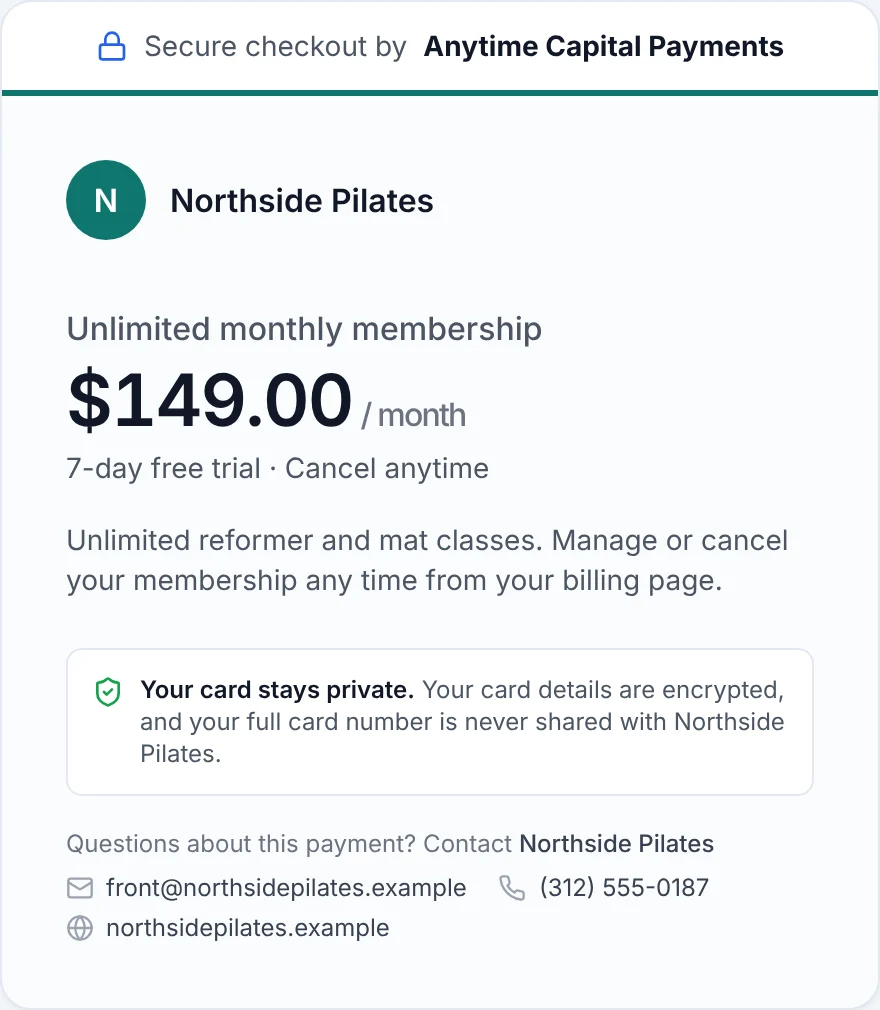
Brex is built for money going out. Anytime Capital is built for both directions. We found no card-acquiring product at Brex, so a company that sells online pays a separate processor and waits on its payouts. Anytime Capital Payments takes cards and wallets at 2.75% + 30¢ ($3.05 on a $100 sale) and pays out to your bank, instant where eligible.
Paying abroad works differently too. Brex sends wires. Anytime Capital's payouts to suppliers and contractors on local rails in 71+ countries (SEPA Instant, Faster Payments, PIX, SPEI, UPI, PayNow and mobile money), in minutes to the same day, with SWIFT for the rest; today it sends USDC and USDT from the business's own wallet.
On digital dollars, Brex announced stablecoin payments in September 2025, starting with USDC: accepting stablecoins with automatic conversion to dollars, sending them from USD balances and paying card balances in them. We could not confirm general availability as of October 2026. Anytime Capital takes USDC and USDT at checkout straight to the business's own wallet, where it can hold them, send them or sell them for dollars, and its crypto desk trades 38+ assets at desk-quoted rates.
Running both, or moving over
Larger companies often run both: Brex for cards, policy and travel at headcount, Anytime Capital for getting paid, paying suppliers abroad and handling crypto, with the two reconciling in dollars.
Smaller companies frequently do not need a spend-management suite at all. Anytime Capital covers card payments, stablecoins and crypto today, with a live US business team and custom pricing once card volume passes $1M+ a year.